
Key Takeaways
- Ozempic face describes the hollow, sagging and aged look that can follow rapid weight loss on GLP-1 drugs.
- It happens because facial fat pads shrink faster than skin can shrink back.
- Treatment ranges from dermal fillers and biostimulators to RF skin tightening and, in some cases, a facelift.
- Slowing weight loss, eating enough protein and staying hydrated all help protect facial volume.
- Most people see a fresher look within a few weeks of starting volume restoration.
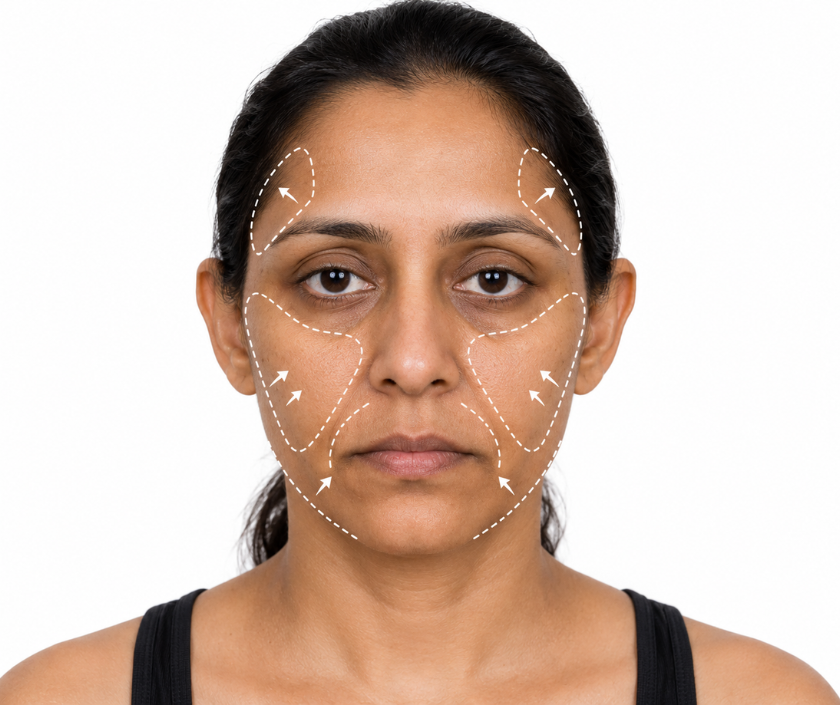
Rapid weight loss while using a GLP-1 medication can reduce facial fat volume as overall body weight falls. When facial volume decreases faster than the skin adapts, the temples and cheeks may look hollow, folds can become more visible, and laxity around the jawline or neck may become more noticeable. Often called Ozempic face, these changes are not one single problem: volume loss and skin laxity need to be assessed separately because they may require different treatments.
The term does not describe a recognised disease caused specifically by one medication. Similar facial changes can occur after substantial weight loss from diet, bariatric surgery or other weight-management treatments. GLP-1 medicines have made the appearance more widely discussed because some people experience substantial weight loss while taking them.
The key question is not simply, “How do I add volume back to my face?” It is: Has the face lost volume, developed loose skin, or both?
That distinction helps determine whether the appropriate approach involves filler, fat grafting, skin-quality treatment, lifting surgery, or simply allowing more time for the face to settle after weight stabilises.
Why Does Rapid GLP-1 Weight Loss Change the Face So Quickly?
Facial appearance depends partly on several compartments of fat beneath the skin.
These compartments contribute to:
-
Cheek projection
-
Temple fullness
-
Mid-face support
-
Smooth transitions around the eyes
-
Jawline contour
-
Support for the overlying skin
When overall body fat decreases, facial fat can decrease as well.
If weight loss is substantial, the difference can become particularly noticeable in someone who already had a relatively lean face.
The result may include:
-
Hollow temples
-
Flatter cheeks
-
More visible under-eye hollows
-
Deeper-looking nasolabial folds
-
Increased marionette lines
-
Jowling
-
Looser neck skin
These changes are often grouped under the term Ozempic face.
More information about the overall pattern is available on the Ozempic face condition page.
Is Ozempic itself ageing the skin?
The visible change is better understood in the context of weight loss rather than assuming the medicine directly “ages” the face.
When underlying facial volume decreases, the existing skin has less structural support beneath it.
That can make folds, hollows, and laxity more visible.
Age also matters.
Younger skin with good elasticity may adapt more effectively after weight loss. Older or previously sun-damaged skin may have less ability to contract around the smaller facial volume.
This is why two people who lose a similar amount of weight can experience very different facial changes.
Does Mounjaro Cause the Same Facial Changes?
The same general issue can occur with significant weight loss associated with other medications, including tirzepatide, commonly known by brand names including Mounjaro.
This is sometimes informally called Mounjaro face.
Again, the important factor is not simply the brand of medication.
Substantial loss of body weight can reduce facial fat regardless of how that weight loss was achieved.
The degree of facial change can depend on:
-
Starting facial volume
-
Total amount of weight lost
-
Age
-
Genetics
-
Skin elasticity
-
Facial bone structure
-
Previous facial treatments
-
Weight-loss pattern
-
Current weight stability
How Do You Tell Volume Loss Apart From Skin Laxity?
This is the most important distinction when planning treatment for facial volume loss after weight loss.
Volume loss and laxity can occur together, but they are not interchangeable.
Volume loss
Volume loss means there is less underlying soft-tissue fullness supporting the face.
Typical signs include:
-
Hollow temples
-
Flattened cheeks
-
Reduced mid-face projection
-
Increased under-eye hollowing
-
A more skeletal facial appearance
A patient may still have reasonably elastic skin but appear older because the underlying volume has decreased.
That is primarily a volume problem.
Skin laxity
Skin laxity means the skin and supporting tissues have become loose relative to the structures underneath.
Typical signs include:
-
Jowls
-
Loose jawline skin
-
Sagging lower cheeks
-
Loose neck skin
-
Poor definition between the jaw and neck
That is primarily a laxity problem.
When both are present
After major weight loss, many patients have both.
For example, the cheeks may be hollow while the lower face simultaneously develops jowling.
Simply putting increasing amounts of filler into this face may restore some volume but will not necessarily correct the loose lower-face tissue.
Likewise, tightening loose skin without addressing substantial mid-face volume loss may leave the face looking depleted.
Treatment therefore needs to identify which feature belongs to which category.
Patients particularly concerned about cheek volume can read more about Hollow cheeks after weight loss.
Ozempic Face: Change-to-Treatment Guide
| Facial Change | Main Problem | Treatment That May Be Considered | How Long It Lasts | When Surgery May Be Indicated |
|---|---|---|---|---|
| Hollow temples | Mainly volume loss | Carefully selected filler or fat grafting | Filler duration varies by product and area; transferred fat may provide longer-lasting volume when it survives | Surgery is not usually required for isolated temple hollowing |
| Flat or hollow cheeks | Mainly volume loss | Filler or facial fat grafting | Depends on product, technique and individual response | Surgery may be considered when substantial laxity accompanies volume loss |
| Deepened facial folds | Often mixed: volume loss + tissue descent | Restore structural volume where appropriate; selected skin or lifting treatments | Depends on treatment used | Consider lifting when folds are primarily caused by significant tissue descent |
| Jowling | Mainly laxity/tissue descent, sometimes with volume loss | Select non-surgical tightening for mild laxity; surgical lifting for significant laxity | Non-surgical results vary; surgical results are longer-lasting, but ageing continues | When jowling is substantial and non-surgical tightening cannot reposition tissue adequately |
| Loose neck | Mainly skin laxity, sometimes with fat or muscle changes | Selected tightening treatments for mild cases; surgical neck/lower-face procedures for substantial laxity | Depends on treatment | When redundant skin or deeper structural laxity cannot be corrected non-surgically |
Treatment duration varies considerably. No filler, fat grafting procedure, device, or facelift permanently stops facial ageing.
Which Treatments Restore Volume, and How Long Do They Last?
When the main problem is lost facial volume, the treatment should address volume rather than simply tightening the skin.
Two commonly considered approaches are injectable fillers and fat grafting.
Dermal fillers
Dermal fillers can restore selected areas of facial volume without surgery.
They may be considered for:
-
Hollow cheeks
-
Selected temple hollowing
-
Mid-face volume loss
-
Structural support in carefully chosen areas
The objective should not necessarily be to recreate the patient's previous facial size.
Instead, treatment may aim to restore enough structural support to soften a depleted appearance while preserving natural proportions.
How long a filler lasts depends on the product, treatment area, amount used, and individual metabolism.
Repeat treatment may eventually be required.
Fat grafting
Fat grafting involves collecting fat from another body area, processing it, and transferring it to selected facial areas.
It may be considered when more widespread or longer-term volume restoration is desired.
Not all transferred fat survives permanently.
Some is naturally reabsorbed during healing, while the portion that successfully establishes a blood supply may provide longer-lasting correction.
Future weight changes and ageing can still affect the result.
Is filler or fat grafting better?
Neither is automatically better.
Filler may suit someone who:
-
Wants a non-surgical treatment
-
Needs relatively limited correction
-
Wants gradual treatment
-
Is not ready for surgery
Fat grafting may be considered when:
-
Several facial areas have lost volume
-
More substantial restoration is required
-
A surgical procedure is already being considered
-
The patient prefers using their own fat
The decision depends on anatomy, treatment goals, weight stability, and the amount of correction required.
A broader overview is available under Non-surgical options for Ozempic face.
Why More Filler Is Not Always the Answer
This is particularly important in patients who have both hollowing and sagging.
Suppose the cheek is depleted, but the lower face has significant laxity.
Adding volume to the cheek may improve the hollow appearance. However, repeatedly adding filler in an attempt to “lift” substantial jowling can eventually make the face look heavier without correcting the underlying tissue descent.
Volume restoration should therefore be used for genuine volume deficiency.
Loose tissue needs to be assessed separately.
Which Treatments Address Laxity, and When Is Surgery Needed?
Mild facial laxity may sometimes be managed with non-surgical treatments intended to improve skin quality, collagen remodelling or tissue firmness.
The appropriate technology depends on factors such as:
-
Degree of laxity
-
Skin thickness
-
Facial area
-
Age
-
Existing volume loss
-
Treatment goals
Mild laxity
When there is early loss of firmness without substantial hanging skin, non-surgical tightening may provide a modest improvement in selected patients.
Expectations should remain realistic.
These treatments cannot reproduce the mechanical repositioning achieved by surgery.
Moderate laxity
As jowling becomes more visible, the limitations of non-surgical treatment become more important.
Some improvement in firmness may still be possible, but the treatment should not be presented as equivalent to a facelift.
Significant laxity
When the lower face and neck contain substantial loose tissue, surgical lifting may become the more appropriate option for someone seeking a meaningful correction.
A facelift does something fundamentally different from filler.
It repositions tissues rather than merely adding volume.
Patients with significant laxity can review Surgical options for Ozempic face.
When Is a Facelift the Right Answer?
A facelift is not automatically required simply because someone has lost a large amount of weight.
The decision depends on what remains after weight stabilises.
Surgery becomes more relevant when there is:
-
Significant jowling
-
Loose lower-face tissue
-
Redundant neck skin
-
Poor jawline definition caused by tissue descent
-
Laxity that cannot realistically be corrected with non-surgical treatment
Age alone does not determine candidacy.
A younger patient after major weight loss can sometimes have more laxity than an older patient who has maintained a stable weight.
The anatomy matters more than the number on a birth certificate.
How Is the Face Protected During Ongoing Weight Loss?
This is an important question for patients who notice facial hollowing while still losing weight on a GLP-1 medication.
If substantial weight loss is still expected, the face may continue changing.
That affects treatment planning.
Do not stop prescribed medication just because the face looks thinner
Medication decisions should be discussed with the clinician managing the GLP-1 treatment.
Stopping or changing a prescribed medicine solely for cosmetic reasons without medical guidance is not appropriate.
Avoid chasing every facial change with filler
Treating the face repeatedly while body weight is changing can make long-term planning difficult.
A face that looks depleted halfway through a weight-loss journey may look different once the final weight has stabilised.
Temporary or conservative treatment may sometimes be considered, but aggressive correction during active weight loss can lead to over-treatment.
Maintain appropriate nutrition
Rapid weight loss should not mean inadequate nutrition.
Adequate protein and overall nutritional intake are important for maintaining lean tissue and supporting skin and general health.
Patients using prescription weight-loss medication should follow the nutritional and medical plan provided by their treating clinician.
Preserve muscle through appropriate activity
Resistance exercise and sufficient dietary protein can help support lean body mass during weight loss when medically appropriate.
This will not specifically prevent facial fat loss, but maintaining healthy body composition is preferable to losing excessive lean mass along with fat.
Allow time after weight stabilises
Once weight becomes stable, facial tissues may continue to settle.
This can make it easier to determine which changes are persistent and which treatment, if any, is actually needed.
Does Slowing Weight Loss Prevent Ozempic Face?
There is no guaranteed rate of weight loss that prevents facial changes.
Slower, medically supervised weight loss may give tissues more time to adapt, but age, genetics, total weight lost, and baseline facial structure also matter.
Someone can lose weight gradually and still develop hollow cheeks.
Another person can lose a substantial amount and retain relatively good facial fullness.
For that reason, treatment should focus on overall health and sustainable weight management rather than attempting to preserve facial fat at the expense of medically appropriate weight-loss goals.
Can the Face Recover on Its Own?
Some facial changes may become less striking once weight stabilises, and tissues have had time to adapt.
However, lost facial volume does not necessarily return simply because the patient stops losing weight.
Similarly, substantial loose skin may not completely retract.
The degree of spontaneous improvement depends on:
-
Age
-
Skin elasticity
-
Amount of weight lost
-
Baseline facial fat
-
Time since weight stabilisation
-
Genetics
This is why permanent corrective procedures are often easier to plan once major weight changes have settled.
Conclusion
Ozempic face is best understood as a combination of changes that may occur when substantial weight loss reduces facial volume and reveals or contributes to skin laxity.
The most important step is separating the two problems.
Hollow temples and cheeks are primarily volume problems. Jowling and loose neck skin are primarily laxity problems. Deepened folds can contain elements of both.
Fillers or fat grafting may help restore appropriate facial volume. Selected non-surgical treatments may improve mild laxity or skin quality. When substantial tissue descent or redundant skin is present, surgical lifting may provide a more appropriate correction than repeatedly adding volume.
Treatment timing also matters. If significant GLP-1-associated weight loss is still underway, the face may continue changing, so conservative management and reassessment after weight stabilisation may sometimes be preferable to aggressive correction.
Dr. Ashutosh Shah at Elegance Clinic can assess facial volume loss, skin laxity, weight stability, and individual treatment goals to determine whether observation, non-surgical volume restoration, skin-tightening treatment, fat grafting, or surgical lifting may be appropriate.
Frequently Asked Questions
Is Ozempic face permanent?
No, it is not permanent. Facial volume can be restored with fillers, biostimulators or fat grafting, and skin laxity can be improved with tightening treatments or surgery. The right combination depends on your skin and how much volume was lost.
How much does treatment cost?
Cost depends on the approach. A single filler session sits at the lower end, while surgical lifting costs more. Most clinics offer transparent quotes and EMI plans, so you can spread payments and choose options that fit your budget.
Is filler safe after weight loss?
Yes, dermal filler is considered safe when performed by a trained provider. It restores lost volume in the cheeks and under eyes with minimal downtime. Your consultation will review your health history and skin to confirm it suits you.
How long is the recovery after Ozempic Face?
Non surgical treatments like filler and RF have little to no downtime, so most people return to daily life the same day. Surgical lifting needs one to two weeks of recovery, with swelling settling over several weeks.
How many Ozempic Face sessions will I need?
Filler often needs just one session, then top ups over time. Biostimulators and collagen treatments usually require two to three sessions spaced weeks apart. Your provider will map out a plan after assessing your face.
Can I prevent Ozempic face?
You can reduce the risk by losing weight more gradually, eating enough protein and staying well hydrated. Good skin care and sun protection also help. Speak with your clinic early so volume loss can be managed before it becomes pronounced.
Reclaim the body you earned
Book a private consultation with Dr. Ashutosh Shah at Elegance Clinic, Surat, for an honest plan made for you.
Book a Consultation
About Dr. Ashutosh Shah
Dr. Ashutosh Shah, M.S., M.Ch. (Plastic Surgery), has over 22 years of experience in body contouring after weight loss. He leads Elegance Clinic, Surat, with centres at Adajan and Vesu, and is known for honest counseling and natural looking results.