Hollow cheeks and a softened jawline after fast weight loss, explained honestly, with the treatment that actually fits your pattern.
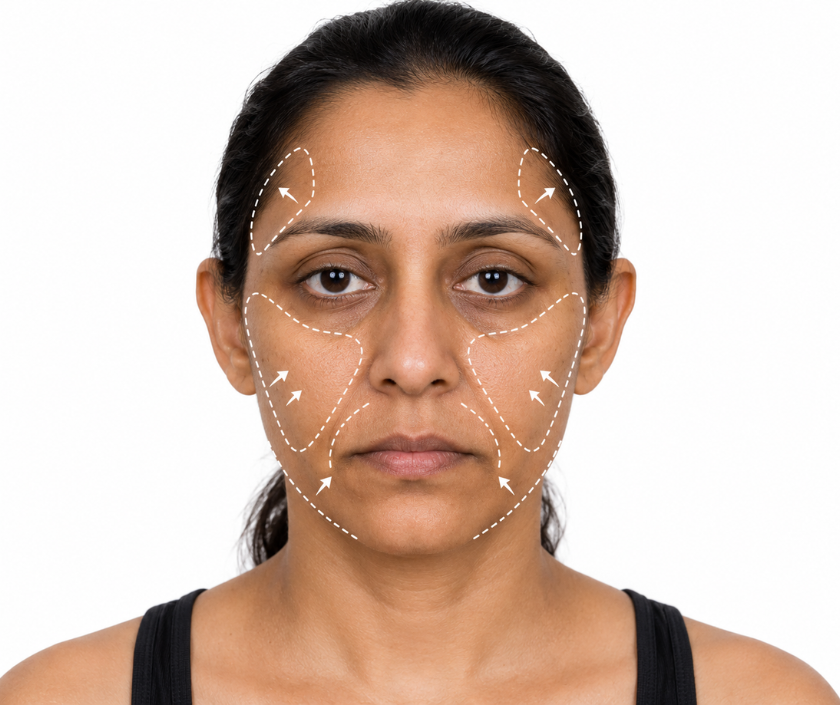
Ozempic face is the hollowing, sagging and sudden ageing of the face that follows rapid weight loss on a GLP-1 medication. It is caused by fat leaving the face faster than the skin can shrink, not by the drug acting on the skin. Treatment restores volume, tightens skin, or both.
The name is misleading, and that matters for what you do about it. Nothing in semaglutide or tirzepatide attacks facial tissue. What happens is that the face is one of the first places the body draws fat from, and on a GLP-1 that loss arrives in months rather than years, which is too fast for skin to keep up. This page covers what changes, what reverses on its own, what does not, which treatment fits which pattern, and when to treat.
Ozempic face describes a cluster of changes that appear together after fast weight loss: hollow cheeks, shadowed under-eyes, a softened jawline, deeper folds around the nose and mouth, and skin that looks loose rather than firm.
The face reads as older, more tired, and often thinner than the person feels. Many patients describe the same thing: the body result is what they wanted, and the face is the part they did not expect.
It is not a complication and it is not a sign anything went wrong. It is the predictable consequence of losing a significant amount of fat quickly. Our Ozempic face condition page covers the signs in more detail.
The weight loss. This is the single most important thing to understand, and it is where most of what you will read online gets it wrong.
Facial fat sits in discrete pads that give the cheek its fullness and support the skin above it. When those pads shrink, the skin over them has nothing to drape across. Skin can retract, but slowly, and only up to a point. Lose the fat over three years and the skin largely keeps pace. Lose it over eight months and it does not.
The American Society of Plastic Surgeons frames it the same way: rapid loss strips volume from the face while the skin fails to retract at the same pace. The effect shows up after any fast weight loss, including after bariatric surgery. GLP-1 medications simply made fast loss common.
That is why the treatment is the same whether your weight came off with Ozempic, Mounjaro, Wegovy, surgery or an extreme diet.
No, and not on the basis of anything you read here. Any decision about starting, stopping, pausing or changing the dose of a prescribed medication belongs to the doctor who prescribes it.
We will say this plainly because it comes up at almost every consultation: we do not advise on your GLP-1 prescription, and you should be wary of any aesthetic clinic that does. What we can do is plan facial treatment around where you are in your weight loss, working alongside your prescriber. Our Mounjaro and Ozempic aftercare programme is built for exactly that.
It is most pronounced in people over about 35, in people who were leaner in the face to begin with, and in anyone losing more than roughly 15 to 20 percent of body weight. Skin quality matters more than age alone: sun damage and smoking both reduce how well skin retracts.
Most people notice it somewhere between three and six months in, usually from a photograph rather than the mirror. It tends to become obvious to others before it becomes obvious to you.
It is not a reason to have treatment immediately. What it is, is a reason to plan.
Partly, and less than most people hope. Skin does continue retracting for roughly twelve to eighteen months after weight stabilises, so the picture at month six is not the final picture.
What does not come back on its own is the lost volume. The fat pads do not refill unless you regain weight, and regaining weight to fix your face is not a plan. So the honest answer is that time improves the skin laxity somewhat and does nothing for the hollowing.
This is why we generally advise waiting rather than treating at the first sign, and then treating what is actually left.
To a degree, yes, and it is worth doing because prevention is easier than correction.
Our GLP-1 support service covers the monitoring side of this while weight is still coming off.
| What you are seeing | What is actually happening | Treatment that fits |
|---|---|---|
| Flat, hollow cheeks | Volume loss in the cheek fat pads | Fat grafting or fillers |
| Dark, shadowed under-eyes | Loss of support below the eye | Fillers, nanofat, or eyelid surgery |
| Crepey, thin skin texture | Collagen loss, no volume to stretch it | Skin boosters, microneedling RF |
| Mild jawline softening | Early skin laxity, volume still reasonable | RF and HIFU tightening |
| Clear jowls and neck banding | Skin excess beyond what tightening reaches | Mini facelift or neck lift |
| Whole-face descent and hollowing | Volume loss plus significant laxity | Deep plane facelift with fat grafting |
Most people need a combination rather than one thing. The commonest real-world plan after large GLP-1 weight loss is volume restoration first, then an assessment of whether skin tightening or surgery is still needed once the volume is back.
Three different jobs, often confused with each other.
Replacing volume. Hyaluronic acid fillers restore shape immediately and last roughly nine to eighteen months depending on product and site. They are the fastest route to looking less hollow and the easiest to over-do, which is where the overfilled look comes from.
Stimulating your own collagen. Biostimulators, skin boosters and energy-based treatments build gradually over two to four months. They will not fill a hollow cheek, but they improve the quality and thickness of thin, crepey skin in a way fillers cannot.
Tightening skin. RF and HIFU work on mild to moderate laxity. On skin that is genuinely hanging they do very little, and the money is better spent elsewhere. If you can gather a fold that stays gathered, no device will fix it.
When the problem is excess skin rather than lost volume. That is the dividing line, and it is assessed by examination rather than from a photograph.
After very large weight loss, particularly over 30 kilos, many patients reach a point where filling adds volume to skin that is still loose, which makes the face look heavier without looking younger. At that point a facelift that repositions tissue, usually combined with fat grafting to replace what was lost, does what injectables cannot.
Fat grafting has a particular advantage here. It uses your own fat, harvested from elsewhere, so it replaces like with like and a proportion of it is permanent. The trade-off is that some of the graft is reabsorbed, so a second session is sometimes needed.
The general rule is to wait until weight has been stable for around three to six months before anything surgical, and to be cautious with volume before that point.
Treating too early is the commonest mistake we correct. Volume placed into a face that then loses another ten kilos has to be redone, and that is an avoidable cost. The readiness criteria on our eligibility and preparation page apply to facial surgery just as they do to the body.
Published ranges, which vary widely by city, surgeon and how much is being treated:
| Treatment | Published range in India |
|---|---|
| Dermal fillers | Rs 20,000 to Rs 35,000 per session |
| Eyelid surgery | Rs 70,000 to Rs 2,50,000 |
| Facelift | Rs 1,50,000 to Rs 5,00,000 |
Facial fat grafting is quoted at consultation rather than as a standard range, because the price depends on how many areas are treated and whether it is combined with other surgery. Anyone publishing a single fixed figure for it is guessing.
These are market ranges, not our quotes. What you are actually charged depends on your assessment, and it varies person to person and plan to plan. Our cost page sets out how a staged plan spreads over 12 to 18 months.
Injectables carry bruising, swelling, lumpiness, and rarely vascular complications, which is the reason to have them done by someone qualified to manage that rather than by whoever is cheapest.
Surgery carries the usual risks of anaesthetic, bleeding, infection and scarring, plus a temporary numbness that is normal and settles.
The limit worth naming honestly is this: treatment can restore fullness and reposition tissue, but it does not return you to the face you had ten years and thirty kilos ago. It gets you to a rested, proportionate version of the face you have now. Patients who understand that are the ones who are happy afterwards.
At consultation Dr Shah assesses whether your main problem is lost volume, loose skin, or both, and tells you which it is before you commit to anything. That single distinction decides whether injectables are worth your money or a waste of it.
Because this clinic treats the whole post-weight-loss picture rather than the face in isolation, facial planning is sequenced against the rest of your staged plan and against where you are in your weight loss. See hollow cheeks, sagging jawline and neck and loose skin after Mounjaro or Ozempic for the individual changes, or contact the clinic in Adajan or Vesu to discuss your own case.
Honest answers about this procedure in Surat.
Ask a QuestionSpeak with Dr. Ashutosh Shah at Elegance Clinic, Surat.
