Hollow cheeks and a drawn look after fast weight loss, explained: what it is, why it happens, and what it is not.
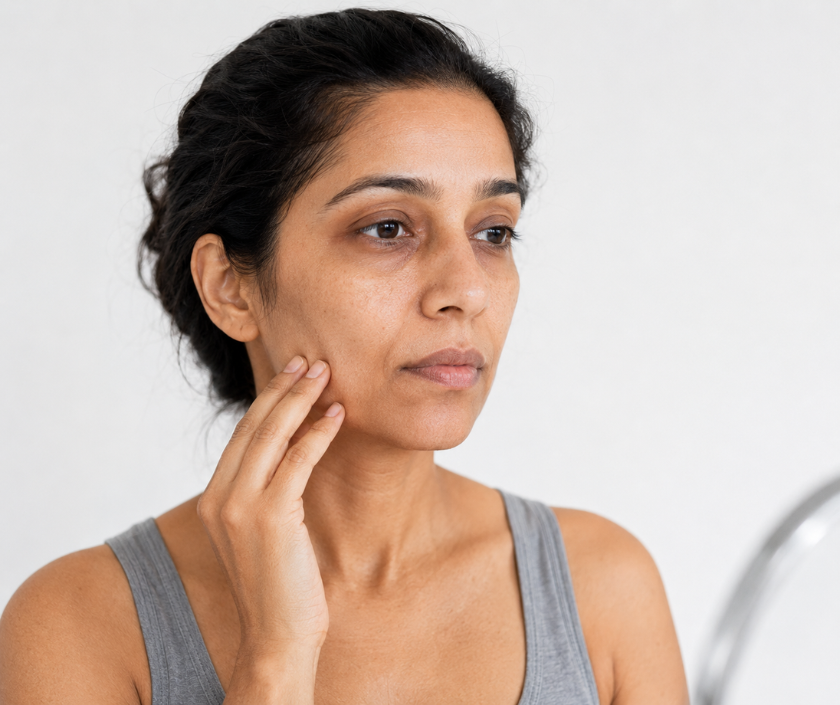
Ozempic face is the sunken, drawn look that appears after fast weight loss on a GLP-1 medication. It shows as hollow cheeks, shadowed under-eyes and a softening jawline. It is caused by facial fat disappearing faster than skin can tighten around it, and it happens after any rapid weight loss.
Most people notice it in a photograph before they notice it in the mirror. The body looks the way they hoped, and the face looks tired, older, and somehow not quite theirs. This page explains what the change actually is, why the face is affected first, and how to tell it apart from ordinary ageing. What to do about it is covered on our Ozempic and Mounjaro face treatment page.
It is a set of changes that arrive together rather than one thing. Recognising the pattern matters, because each part needs a different answer.
Some people get only one or two of these. Others get all six. The pattern depends on age, starting facial fullness and how fast the weight came off.
Because facial fat is metabolically active and easy for the body to reach. It is drawn on early during a calorie deficit, well before the deeper stores around the abdomen give way.
Facial fat is not a single layer. It sits in defined compartments that act as scaffolding, holding the skin out and supporting the structures above. When those compartments shrink, everything resting on them descends. That is why the effect reads as sagging as well as hollowing, even though no skin has actually been added.
The face also has nowhere to hide the change. Ten kilos off the torso is absorbed across a large area. The same proportional loss across a face is immediately visible to anyone looking at you.
Because the changes it produces are the same ones we unconsciously read as age: loss of cheek volume, deepening shadows, a less defined jaw, and thinner skin.
A naturally thin face is not a hollow one. Someone lean since their twenties has skin that fits the structure underneath. Rapid loss creates a mismatch, skin sized for a fuller face draped over a smaller one, and that mismatch is precisely what ageing looks like.
This is why patients so often say they look older rather than thinner. They are reading the change accurately.
Four things it regularly gets confused with, all of which lead people to waste money on the wrong fix.
It is not dehydration. Drinking more water will not refill a fat compartment. Hydration affects skin quality slightly and volume not at all.
It is not a drug reaction. Nothing in semaglutide or tirzepatide acts on facial tissue. The American Society of Plastic Surgeons describes it as rapid loss stripping volume from the face while the skin fails to retract at the same pace.
It is not only about muscle. Lean tissue loss does contribute and is worth preventing, but the dominant change is fat volume. Protein alone will not hold the face up.
It is not a complication. Nothing has gone wrong and no one has made a mistake. It is the predictable arithmetic of losing a lot of fat quickly.
Mention it, yes. Treat it as a reason to change your prescription, no.
Your prescriber should know how you are responding overall, and facial change is part of that picture, particularly if it comes alongside unusual fatigue or weight dropping faster than planned. Those are worth raising.
But the decision to start, stop, pause or adjust a GLP-1 belongs entirely to the doctor who prescribes it. No aesthetic clinic should be advising you on that, and neither should a web page. Our Mounjaro and Ozempic aftercare programme is designed to work alongside your prescriber rather than around them.
No. It is common but far from universal, and the difference is mostly explained by four things.
Sun exposure and smoking both reduce how well skin recovers, which is why two people with identical weight loss can end up looking quite different.
Speed. Facial ageing is a process of years and you adjust to it as it happens. This arrives in months, which is why it registers as a shock rather than a gradual change.
The practical test is a photograph from twelve to eighteen months ago, before the weight loss started. Ordinary ageing over that period is subtle. If the difference is obvious across the cheeks and jawline, and your weight has dropped significantly in the same window, the weight loss is doing most of the work.
It is worth saying that the two combine. In someone over 45 the weight loss has often simply revealed and accelerated changes that were already underway.
Usually yes, until the weight settles. Facial fat continues to be drawn on throughout, so the face at your target weight will be hollower than the face today.
This is the single most useful thing to know if you are still losing, because it decides the timing of everything else. Volume treatment placed now into a face that has another fifteen kilos to go will need redoing. Skin quality work does not have that problem and can start at any point.
Our GLP-1 support service covers the monitoring side while weight is still coming off.
The volume loss is, unless you regain weight. Fat compartments do not refill on their own, and regaining weight to restore your face is not a reasonable plan.
The skin laxity is partly self-correcting. Skin keeps retracting for roughly twelve to eighteen months after weight stabilises, so the face at month six is not the final result. That is the main argument for patience before treating anything surgically.
Broadly, three approaches: replacing lost volume, improving skin quality, and removing or repositioning skin that is genuinely in excess. Which one you need depends on whether your problem is emptiness, texture or looseness, and most people need more than one.
That assessment, the options, the timing and the costs are all set out on our Ozempic and Mounjaro face treatment page. For the individual changes, see hollow cheeks after weight loss, sagging jawline and neck and loose skin after Mounjaro or Ozempic.
There are three sensible moments. If you are still actively losing, an early consultation is useful for planning and for the prevention measures that work best started early. If your weight has just stabilised, that is the point to plan volume. If it has been stable six months or more, everything is on the table.
There is one situation that warrants going sooner rather than later: if the facial change is affecting how you feel about a weight loss you worked hard for. That is a common and reasonable reason to seek advice, and it does not require waiting for a particular milestone.
To discuss your own case, contact the clinic in Adajan or Vesu.
Honest answers about this concern in Surat.
Ask a QuestionSpeak with Dr. Ashutosh Shah at Elegance Clinic, Surat.
